How to Avoid Glass Spontaneous Breakage: The Definitive Guide
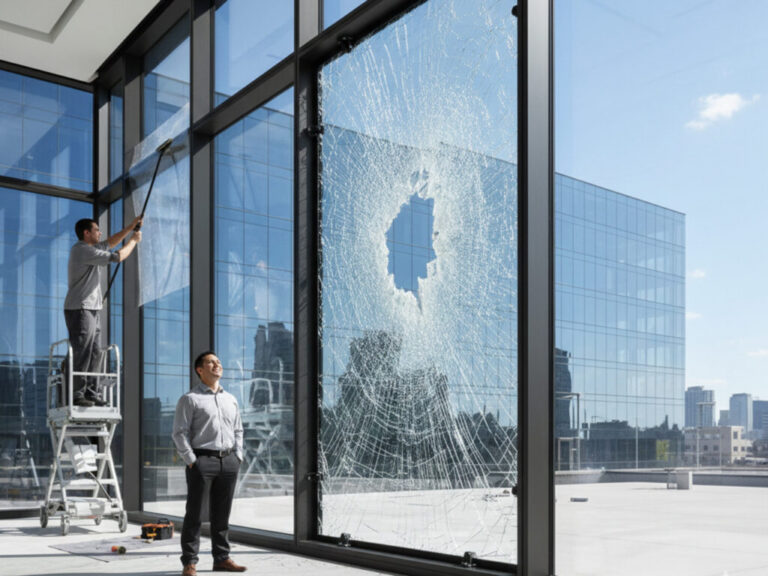
In the specialized field of facade engineering, few events are as unsettling as the sudden, unprovoked failure of a glass pane. To the casual observer, glass is a static material; however, at a molecular level, it is a substance under immense internal tension, particularly when processed for safety and strength. When a window shatters without an apparent external impact, it is rarely a “random” occurrence. How to Avoid Glass Spontaneous Breakage. Instead, it is usually the climax of a microscopic metallurgical conflict or a systemic failure in thermal management that has been developing since the moment of fabrication.
The challenge of modern architecture lies in the increasing demand for larger, thinner, and more transparent spans of glass. As we push the boundaries of what the building skin can achieve, the margin for material impurity and installation error shrinks. A single microscopic inclusion, invisible to the naked eye and undetectable by standard quality control, can act as a literal time bomb within a high-rise facade. Understanding the triggers behind these failures is a prerequisite for any professional tasked with the long-term stewardship of a commercial or residential asset.
Addressing the phenomenon of sudden fracture requires a departure from surface-level maintenance. It demands a rigorous forensic approach to glass chemistry, an understanding of the tempering process, and a strategic view of how a building’s structural movement interacts with its glazing. By moving beyond the reactive “replace as it breaks” mentality, engineers and developers can implement defensive strategies that prioritize safety, reduce liability, and maintain the aesthetic continuity of the vertical city.
Understanding “how to avoid glass spontaneous breakage”
In the professional lexicon, the inquiry of how to avoid glass spontaneous breakage is primarily focused on the stabilization of tempered glass. While the term “spontaneous” suggests an event without a cause, in technical reality, it is almost always the result of internal stress exceeding the material’s tensile strength. The primary culprit is often Nickel Sulfide (NiS) inclusions—tiny metallic stones that can accidentally enter the glass melt during production. When glass is tempered (heated and rapidly cooled), these inclusions are trapped in a high-temperature crystalline phase. Over months or years, they naturally transition back to a low-temperature phase, expanding in volume by up to 4% and shattering the glass from the inside out.
A common misunderstanding in the industry is that all safety glass is equally prone to this issue. In reality, heat-strengthened glass—which is cooled more slowly than fully tempered glass—rarely experiences NiS-induced failure because its internal tension is significantly lower. To manage this risk effectively, one must distinguish between “safety” requirements (where tempered glass is mandated to break into small, blunt pieces) and “stability” requirements (where the goal is to prevent the glass from breaking at all).
Furthermore, oversimplification occurs when stakeholders overlook the role of installation and framing. A glass pane that is “nipped” at the edge during transport or squeezed too tightly by a rigid aluminum frame will develop localized stress concentrations. Under the right thermal conditions, this localized pressure acts as a catalyst, causing a fracture that appears spontaneous but is actually the result of mechanical interference. Solving this problem requires a holistic view that encompasses the entire lifecycle from the furnace to the final gasket seal.
Deep Contextual Background: The Evolution of Glass Stability
The history of glass fracture is inextricably linked to the development of the float glass process. Prior to the mid-20th century, most architectural glass was annealed—relatively stable but dangerous if broken, as it produced large, sharp shards. The drive toward high-rise construction necessitated “safety glass,” leading to the widespread adoption of thermal tempering. However, by the 1960s and 70s, as glass towers became the architectural standard, reports of “spontaneous” failures began to climb.
It took decades of metallurgical research to identify the NiS inclusion as the primary antagonist. This discovery led to the development of the “Heat Soak Test” (HST), a process where tempered glass is placed in a secondary oven for several hours to accelerate any potential NiS expansion. Units with inclusions are intended to break in the oven rather than on the building. While the HST significantly reduced failure rates, it added a layer of cost and lead-time that continues to influence procurement strategies today.
In the current era, we are seeing a move toward laminated glass as the ultimate fallback. By bonding two panes of glass together with a tough plastic interlayer, even a “spontaneous” breakage becomes manageable; the shards remain adhered to the interlayer, preventing the “glass rain” that can be lethal in urban environments. The modern frontier of stability is now focused on “low-nickel” manufacturing processes and advanced digital scanning that can detect inclusions before the glass even enters the tempering furnace.
Conceptual Frameworks and Mental Models
To evaluate and mitigate the risk of sudden fracture, engineers rely on several predictive frameworks.
1. The Critical Inclusion Threshold
This model assumes that not all inclusions are fatal. The risk is a function of the inclusion size, its location within the “tension zone” of the glass (the inner 60% of the thickness), and the ambient temperature of the environment.
-
Limit: It is impossible to calculate this for every pane; instead, it is used to set factory tolerances for raw glass batches.
2. The Thermal Gradient Stress Model
A framework that views the window as a dynamic system. It calculates how much “bowing” or internal expansion occurs when the center of a pane is heated by the sun while the edges are chilled by a cold aluminum frame.
3. The Redundancy and Containment Framework
This mental model accepts that a small percentage of breakage is statistically inevitable. The focus shifts from “prevention” to “containment”—ensuring that if a pane fails, it does not fall or compromise the building’s envelope.
Key Categories and Technical Variations
Understanding the trade-offs between different glass types is the most direct way to address the question of how to avoid glass spontaneous breakage.
| Glass Type | Breakage Risk (NiS) | Safety Profile | Primary Trade-off |
| Annealed | Zero | Dangerous shards | Very low structural strength; not for high-rise. |
| Heat-Strengthened | Negligible | Large shards | 2x stronger than annealed; not “safety glass” alone. |
| Fully Tempered | High | Small blunt pieces | 4x stronger than annealed; high internal tension. |
| Heat-Soaked Tempered | Very Low | Small blunt pieces | Added cost/time; still 1% risk of surviving inclusions. |
| Laminated (Annealed) | Zero | Shards stay in frame | Heavy; more expensive; lower wind-load capacity. |
| Laminated (Tempered) | Moderate | Best-in-class | Most expensive; heaviest; highest safety and strength. |
Decision Logic: The Hierarchy of Safety
For a high-rise facade, the decision path usually favors Heat-Strengthened Laminated glass for the outer pane. This configuration offers the structural strength needed for wind loads while virtually eliminating the risk of NiS-induced spontaneous fracture. Fully tempered glass should be reserved for specific “safety” zones (like doors or low-level partitions) where impact by humans is the primary risk.
Detailed Real-World Scenarios
Scenario A: The High-Altitude Glass Prow
An iconic skyscraper features an angled glass “prow” that catches intense morning sun.
-
Constraint: Extreme thermal gradients between the sun-drenched center and the shadowed edges.
-
Decision Path: Use heat-strengthened glass rather than fully tempered. Because heat-strengthened glass has lower internal stress, it is more resilient to the “thermal pull” created by the temperature difference.
-
Failure Mode: If tempered glass were used without heat-soaking, the thermal expansion of the center would “un-zip” a pre-existing NiS inclusion.
Scenario B: The Interior Retail Partition
Large, heavy tempered glass panels used as dividers in a shopping mall.
-
Constraint: High pedestrian traffic; risk of edge-impact from cleaning equipment or carts.
-
Decision Path: Laminated tempered glass with polished, “cushioned” edges.
-
Result: If a panel is struck on the edge (the most vulnerable point of tempered glass), it may shatter, but the lamination keeps the heavy panel from falling onto shoppers.
Planning, Cost, and Resource Dynamics
The economics of preventing breakage are often a matter of “insurance.” Is it cheaper to pay for heat-soaking now or for a crane and street closure later?
| Cost Element | Relative Increase | Value/Risk Mitigated |
| Standard Tempering | Baseline | Provides basic structural safety. |
| Heat-Soaking (HST) | 10% – 15% | Eliminates ~95% of NiS-related breakage. |
| Lamination | 40% – 60% | Prevents falling glass; improves acoustics. |
| Heat-Strengthening | 5% – 10% | Virtually eliminates NiS risk; requires more thickness. |
Opportunity Cost: The “Crane Factor”
In a dense urban center, the cost of the glass pane itself is often less than 5% of the total cost of replacement. A $500 pane of glass can require a $10,000 mobilization of a specialized Building Maintenance Unit (BMU) or a crane, plus the legal costs of street permits and police presence. Proactive heat-soaking or lamination is almost always the more economical long-term choice.
Tools, Strategies, and Support Systems
The management of glass stability requires a sophisticated technical toolkit.
-
Heat-Soak Ovens: Calibrated to EN 14179 standards to ensure the temperature profile effectively triggers NiS expansion.
-
Laser Stress-Meters: Non-destructive tools used on-site to verify if glass is fully tempered or heat-strengthened.
-
Inclusion Scanning (Digital): New AI-driven scanners in factories that identify stones within the glass ribbon before it is cut.
-
Edge Polishing Machines: Ensuring that the edges of the glass are free of “micro-vents” or chips that act as stress-risers.
-
Setting Blocks (EPDM/Silicone): Specialized “cushions” that prevent the glass from making direct contact with the metal frame.
-
Thermal Modeling Software: Used during design to predict if specific shadow patterns will cause a pane to exceed its thermal stress limit.
Risk Landscape and Failure Modes
The “spontaneous” fracture is often the result of multiple risks compounding at once.
-
Nickel Sulfide (The Primary): A metallurgical inclusion that expands over time.
-
Thermal Stress (The Catalyst): Cold edges and hot centers causing the glass to bow and pull against its internal tension.
-
Edge Damage (The Weak Link): A chip in the glass edge effectively “pre-starts” a crack that only needs a small amount of thermal or wind pressure to complete.
-
Structural Binding: If a building settles or sways and the glazing pocket is too tight, the frame will “pinch” the glass, causing it to shatter.
Governance, Maintenance, and Long-Term Adaptation
A glazing system is not “static.” It requires a governance structure to manage its lifecycle.
The Maintenance Checklist
-
Post-Installation Audit: Use a polariscope to check for uneven stress patterns that might indicate the glass is “binding” in the frame.
-
Quarterly Visual Check: Look for “scalloped” chips at the edges or any movement in the gaskets.
-
Sealant Integrity: Ensure that structural silicone is not debonding, which could allow the glass to vibrate or “clatter” in the frame during wind events.
Adjustment Triggers
If a building experiences more than two spontaneous breakages in a single year within a specific facade, it is no longer a random event. This should trigger a forensic audit of the glass batch records and a thermal imaging scan of the facade to identify systemic “hot spots.”
Measurement, Tracking, and Evaluation
How do we prove the effectiveness of a breakage-avoidance strategy?
-
Leading Indicators: HST certification logs for every batch; edge-quality inspection reports from the fabricator.
-
Lagging Indicators: The “breakage rate” per 1,000 units over the first five years of the building’s life.
-
Documentation Examples:
-
The Glass Batch Log: Identifying which panes came from which “melt” to allow for targeted replacement if a bad batch is discovered.
-
The “Butterfly” Record: Capturing the center-point of a break (the “butterfly” pattern is characteristic of NiS) to prove the cause for insurance or warranty claims.
-
Common Misconceptions and Industry Oversimplifications
-
Myth: “All glass breakages are spontaneous.”
-
Correction: Most “spontaneous” breaks are actually caused by undetected impact or edge damage. True NiS failure is statistically rare but highly publicized.
-
-
Myth: “Heat-soaking is a 100% guarantee.”
-
Correction: Heat-soaking is a statistical reduction. Roughly 1% to 5% of NiS inclusions can still survive the test and fail later.
-
-
Myth: “Thicker glass is less likely to break spontaneously.”
-
Correction: Thicker glass actually has a higher risk of thermal stress breakage because it can maintain a larger temperature gradient through its thickness.
-
-
Myth: “Tempered glass is always better than annealed.”
-
Correction: For high-performance facades, heat-strengthened glass is often superior because it avoids the NiS risk while still offering enough strength for wind loads.
-
Ethical and Contextual Considerations
The avoidance of glass breakage is ultimately a matter of urban safety. In dense pedestrian environments, the failure of a single pane at the 40th floor is not just a maintenance issue; it is a life-safety event. Developers have an ethical obligation to specify laminated glass or heat-strengthened configurations in “overhead” or “public-facing” zones. While energy codes drive the thermal performance of our windows, our moral obligation must drive their structural stability.
Conclusion
The pursuit of how to avoid glass spontaneous breakage is an exercise in technical humility. It requires an acknowledgment that we cannot perfectly control the chemistry of the earth’s raw materials, but we can control how we process and protect them. By prioritizing heat-strengthened glass and lamination over the raw strength of tempering, we can create buildings that are not only transparent and beautiful but are also profoundly stable. The goal is a facade that performs its duty in silence—resisting the sun, the wind, and its own internal pressures for decades without incident.